Guide
How to get ChatGPT and other assistants to recommend your site
A straight guide for business owners who want to show up and get cited in answers from assistants like ChatGPT, Gemini and Perplexity. No tricks, just the steps that actually work.
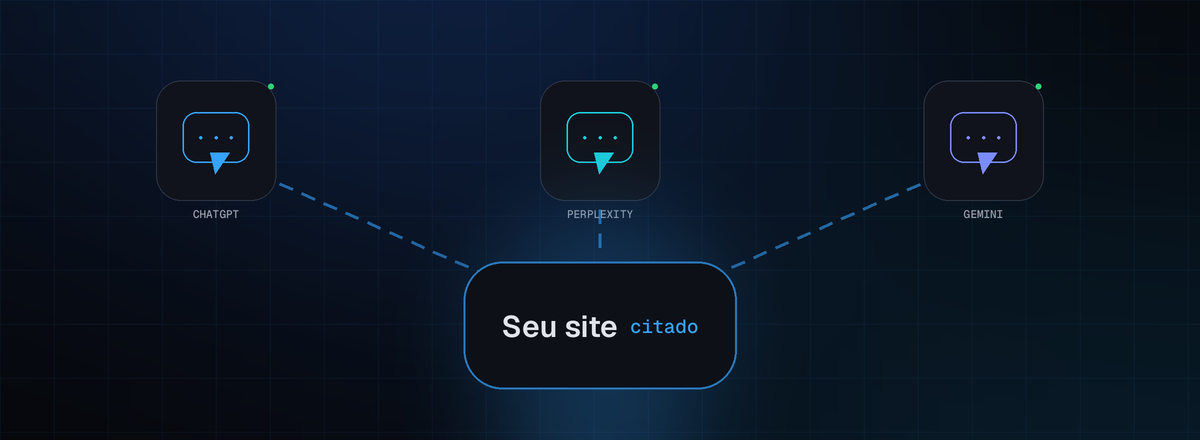
More and more people have stopped searching and started asking. Instead of opening Google and comparing ten links, a person types into ChatGPT “what is the best [service] company near me” and gets a short answer, with two or three names. If your business is not in that answer, to that customer you barely exist.
You can do a lot to raise the chance that your site gets found, understood and cited by these assistants. It is not a guarantee, and anyone promising a guaranteed spot is selling you a fantasy. It takes technical work, clear content, and trust signals that come from outside. This guide shows what works, in plain business-owner language.
What GEO is, without the fluff
GEO means generative engine optimization. Some people call it AEO, answer engine optimization. Both names point to the same goal. Making your site get found, cited and recommended when someone asks ChatGPT, Gemini or Perplexity.
Here is the truth that saves you money. There is no secret machine language. Google itself has said that, for it, this is still good SEO. In other words, no magic formula. What counts is being clear, being readable by the machine, and being confirmed from outside. The rest of this guide just spells out those three things.
Think of the shop window. It does no good to keep your best product stashed at the back of the storeroom, in the dark. You need to put it in the window, with the right sign, where anyone walking by can read it.
How an answer is built
Before touching the site, understand the path. When someone asks, the assistant searches the internet, opens a few pages, reads the content, and only then writes the answer, citing where it pulled the information from. It is fast and it happens on the spot.
Each assistant searches in its own way. ChatGPT has its own search systems and a specific bot, OAI-SearchBot, that looks for pages to feed into the answers. The Bing index also powers part of this, so showing up in Bing helps. Perplexity has its own search. Gemini leans on Google. The practical point for you is simple. It is live search, so you can improve your presence without waiting years.
Mistake number 1: your site might be invisible
This is the most common problem and the easiest to fix. Most of these bots read the plain HTML of the page and move on. Many do not run the JavaScript and do not wait for the page to load. Google’s search bot is an exception that can build the page, but you do not want to bet against the others.
In short. Plenty of modern sites arrive almost empty and build the content in the browser, after the page opens. For the customer it works fine. For most bots, the page looks like a blank sheet. They read little or nothing and move on.
The safe rule is just one. The main content, the text, the headings and the links, has to already come finished in the HTML. You do that with server-side rendering or a static page. Without it, the rest of this guide does not matter, because the assistant never even reads your page. A site that is not read is not recommended.
It is the kind of thing you can check quickly. In many cases it is the only fix standing between the site and its first citation.
Let the right bots in
There is a simple file, robots.txt, that says which bots are allowed into the site. A lot of people, without meaning to, block exactly the ones that build the answers. It is worth checking that the search bots from the assistants are allowed in. A minimal list looks like this:
User-agent: OAI-SearchBot
Allow: /
User-agent: ChatGPT-User
Allow: /
User-agent: PerplexityBot
Allow: /
User-agent: Claude-SearchBot
Allow: /
With Google the care is different. To show up in search, do not block Googlebot, which is already allowed by default. There is a separate control, Google-Extended, that decides whether your content can be used in products like Gemini. It is not the one that puts you in Google search, so do not mix the two up.
The shortcut almost nobody uses. The Bing index powers part of ChatGPT’s answers. If Bing does not know your page yet, it gets harder for ChatGPT to cite it. Register your site in Bing Webmaster Tools and submit your sitemap. It is cheap and it usually pays off.
Write the answer first
Here is what raises the chance of being cited the most. Start each page by answering the question in the very first lines, in two or three direct sentences. The assistant usually grabs a ready-made snippet, not the whole page.
A few simple rules that make a difference:
- A title that is the customer’s question. Something like “How much does it cost to automate customer service for a small business?” with the answer right below it.
- Short blocks. Each part between 200 and 400 words, complete on its own. The assistant quotes snippets, not the whole page.
- Concrete data. Numbers, dates and named sources. A study from Princeton University showed that citing sources and data raises the chance of a page being picked a great deal. A vague sentence loses to a sentence with a number.
- A questions-and-answers section at the end. It helps the reader and it helps the machine.
This article follows the same format it recommends. A direct answer at the top, short blocks, clear terms, and a list of questions at the end. That is on purpose.
Be the obvious answer to a specific question
Being found is one thing. Being recommended is another, and harder. To recommend you, the assistant has to be sure you are the right answer to that question.
And that is where focus comes in. “We do automation” is too generic and gets lost in the crowd. “We automate order triage on WhatsApp for clinics” is specific and wins. The clearer your angle, the easier it is to become the obvious answer to a question.
It is worth writing for the customer’s three moments. The one who is learning, the one who is comparing, and the one who is ready to hire. Content that compares honestly is what turns into a recommendation most often.
Who backs up what you say
The assistants recommend what shows up confirmed in several places, not just on your own site. They are wary of anyone who only speaks well of themselves. What counts is your name showing up, cited from outside, in sources the model already considers trustworthy.
What you can do, for real:
- Show up on sites in your field. An interview, a guest article of yours, being the source for a piece of news. It is worth more than an ad.
- Details that always stay the same. Name, address and phone identical everywhere. A complete and correct Google Business Profile. One piece of information clashing with another makes the assistant wary and skip your name.
- Customer reviews. Volume and consistency show that the business is real and active.
One important warning. The confirmation has to be genuine. A bought mention leaves a trail, and the next section explains why.
What does not work, and still costs you money
Before spending on a miracle promise, keep this list. It protects your wallet.
- That savior llms.txt file. Google confirmed it does not use it. It costs little to add and does no harm, but it is not what gets you mentioned.
- Writing in a secret machine language. It does not exist. The models understand text that is well written for people.
- Stuffing the page with technical markup. It helps with organization, but on its own it barely changes citation. What counts is clear content backed by data.
- Repeating a keyword until it is exhausting. Worse still. A study showed this performs worse than changing nothing at all.
- Buying mentions online. The systems that filter spam keep the history, including what was deleted. A fake mention becomes a bad signal that sticks.
Did you notice the pattern? Almost everything sold as a robot trick is either useless or works against you. What wins is work done well.
How to measure if it is working
You can keep track without expensive tools. There are three things to watch.
- Ask like a customer. Once a month, run the 20 or 30 questions a customer would ask, in ChatGPT, Gemini, Claude and Perplexity. Note where you show up and where your competitor shows up. That is your scoreboard.
- Look at the site’s access. In the access logs you can see the assistants’ search bots passing through. More visits from these bots on a page is a good sign.
- Flag the traffic in Google Analytics. Separate the visits that come from these assistants. Just know one thing. The apps hide the origin, so a good share will land under “Direct”.
Set your expectations. Most citations do not bring a click. The gain is being present and being recommended in the answer, which is where the decision starts today.
In short
For an assistant to recommend your site, three things matter most. The content has to be in the HTML, ready for the bot to read. Each page has to answer a question right at the start. And your brand has to show up confirmed from outside.
It is not a trick. It is good SEO plus text that is ready to be quoted. Do those three well before spending on any miracle promise.
Want to know if your site is ready?
Want to know if your site is already readable to these assistants? We run a short diagnosis. We look at the HTML, the indexing, the robots.txt, Bing, Google, the content of the pages, and the trust signals that show up from outside. You get a list of what to fix first and why.
If you like, we will also get all of this running and hand you a monthly report showing where your company already gets cited.
Frequently asked questions
What is GEO and what is AEO?
GEO means generative engine optimization, and AEO means answer engine optimization. Both names point to the same goal. Making your site get found, cited and recommended when someone asks an assistant like ChatGPT, Gemini or Perplexity. In practice it is good SEO plus text that answers the question directly.
Do I need an llms.txt file to be cited by AI?
No. Google confirmed it does not use that file, and no major assistant has said it decides who gets cited. It costs little to add and does no harm, but it is not what gets you mentioned. What puts you in the answer is clear content, a site served as HTML, and your brand confirmed on other sites.
Why does ChatGPT not find my site even though it is live?
The most common reason is that the site builds its content only in the browser, with JavaScript. Most of the search bots from ChatGPT, Claude and Perplexity read plain HTML and do not wait for that to load. If the text is not in the initial HTML, they see an almost empty page. The fix is to serve the content already finished in the HTML, with server-side rendering or a static page.
How long does it take to show up in AI answers?
There is no guaranteed date. Because live search counts for a lot today, some changes show up within a few weeks, as soon as the right content makes it into the search indexes. Others depend on crawling, on competition, and on the trust you build over time. The right move is to measure every month, not to promise a deadline.
Do buying mentions and stuffing the page with keywords help?
No, they hurt. Keyword stuffing performs worse than changing nothing at all, according to a university study. And a bought mention leaves a trail in the systems that filter spam, becoming a permanently bad signal. What works is real mentions on sites in your field, customer reviews, and details about your business that always stay the same.
How do I know if AI is citing my business?
Ask the questions a customer would ask in ChatGPT, Gemini, Claude and Perplexity, every month, and note where you show up. Also check your site's access logs for the search bots from these assistants, and flag the traffic that comes from them in Google Analytics. That monthly check becomes your scoreboard.
Frota AI
Want this running in your company without setting anything up?
We build the right automation for your business and hand it to you working.
Book an assessment →